Guide
Conrad Challenge: build the venture, not just the prototype
How to turn a student invention into a tested solution, a credible business case, and a pitch that can survive scrutiny.
Competition Roundups
A realistic framework to help UK students balance academic competitions, schoolwork, and long-term development
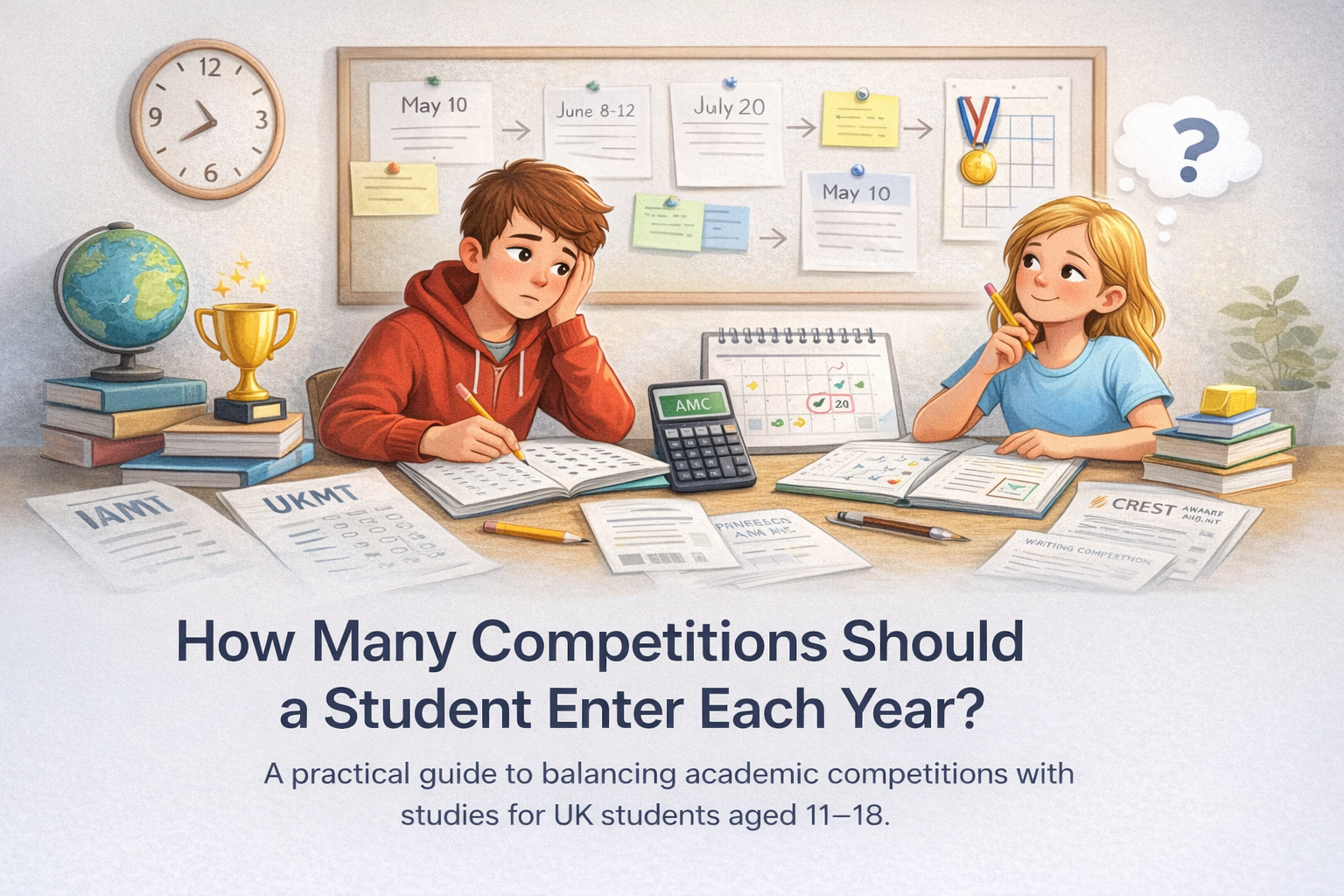
Many parents and students wonder how many academic competitions are “too many”. With maths challenges, science projects, essay contests, coding competitions, and Olympiad pathways available, it’s easy to feel that entering more competitions will automatically lead to better results or stronger university applications.
In reality, the number of competitions a student should enter each year depends on their age, goals, and workload. A thoughtful approach usually leads to better outcomes than simply entering as many competitions as possible.
For most UK secondary school students, a sensible annual range is:
This range allows students to gain experience without becoming overloaded. Entering too many competitions often reduces preparation quality and increases stress, which can actually harm performance and enjoyment.
It’s tempting to sign up for every opportunity, but this approach has drawbacks:
Competitions reward deep thinking and practice. Spreading time across too many contests means students may prepare properly for none of them.
Academic competitions should feel stimulating, not exhausting. If students feel constantly under pressure, they may lose interest entirely.
Universities and schools tend to value meaningful engagement and progression, not long lists of unrelated competitions.
A smaller number of competitions with clear improvement or achievement usually has greater impact.
A useful framework is to divide competitions into two categories:
These align with a student’s strongest or most important subjects.
Examples:
Core competitions should receive the most preparation time and attention.
These allow students to try new areas with lower pressure.
Examples:
Exploration competitions help students discover interests without overwhelming their schedule.
Goal: exposure and confidence
Typical plan:
Focus should be on enjoyment and learning how competitions work.
Goal: skill development and subject direction
Typical plan:
Students often begin showing stronger preferences here, so competition choices should start reflecting long-term interests.
Goal: depth and achievement
Typical plan:
At this stage, fewer but more meaningful competitions are usually more valuable than broad participation.
A healthy competition load usually means:
If preparation feels rushed or stressful, it may be a sign to reduce the number of competitions.
The biggest difficulty for many families is not deciding how many competitions to enter — it’s knowing which competitions are available and suitable in the first place.
If you want to explore maths, science, coding, writing, and other competitions for UK and Ireland students — including eligibility and deadlines — you can browse them here:
CompeteMap helps students and parents quickly identify appropriate competitions and plan participation throughout the academic year.
EXPLORE NEXT
Guide
How to turn a student invention into a tested solution, a credible business case, and a pitch that can survive scrutiny.
Guide
Who can enter the 2027 U.S. edition, what the application requires, and how the two-stage selection works.
Guide
How to curate a coherent application without polishing away the artist behind it.
Comments
Share a question, note, or update.
No comments yet.