Guide
National STEM Festival U.S.: Future Rising Starts with a Working Idea
Who can enter the 2027 U.S. edition, what the application requires, and how the two-stage selection works.
Competition Guides
A complete guide explaining how students in the UK and Ireland qualify for the world’s most prestigious pre-university science research competition.
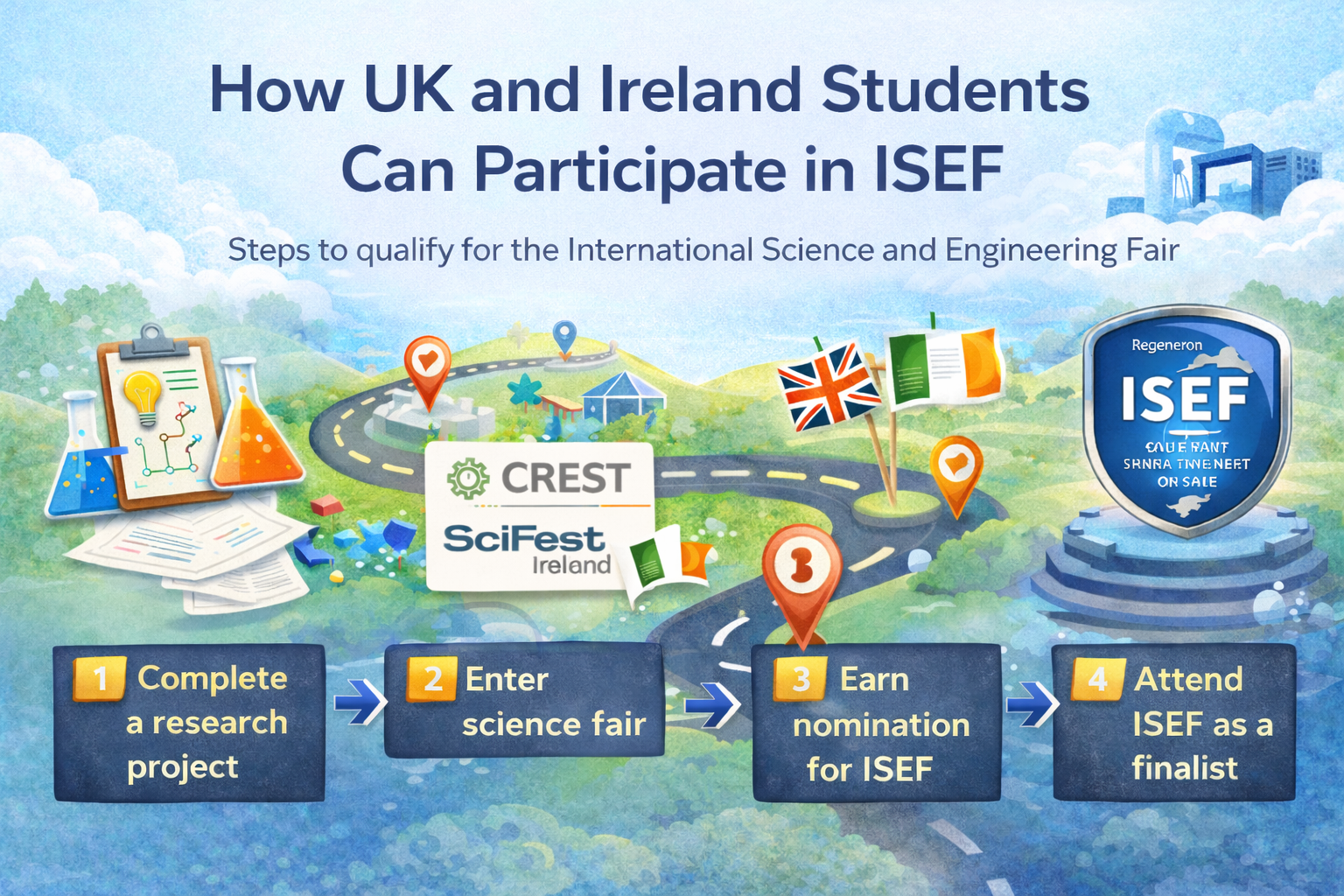
The International Science and Engineering Fair (ISEF) is one of the most prestigious science research competitions for secondary school students worldwide. Finalists present original research projects in fields such as biology, engineering, environmental science, physics, mathematics, and computer science.
ISEF is not an open-entry competition. Students cannot register directly. Instead, they must qualify through official affiliated national or regional science fairs in their country.
Because qualification systems differ, students in the UK and Ireland typically follow separate pathways to reach ISEF.
ISEF is widely considered one of the highest-level STEM competitions available to school students.
Each year:
ISEF is often described as the global championship of secondary-school scientific research.
ISEF participation demonstrates:
For students applying to competitive universities — especially in STEM subjects — reaching ISEF can be a major academic distinction.
Top universities recognise ISEF as evidence of:
ISEF provides:
Even for students who do not win major prizes, presenting research at ISEF offers valuable experience in scientific communication and global collaboration.
Yes — students from both the UK and Ireland can participate in ISEF.
However:
The pathway therefore focuses on research quality + national-level selection.
Unlike some countries, the UK does not have a single nationwide competition that automatically qualifies students for ISEF.
Instead, UK students typically reach ISEF through official ISEF-affiliated regional science fairs or national selection programmes, which may vary from year to year.
Students begin by completing an independent STEM research or engineering project. Strong projects usually include:
ISEF-level projects often take 6–12 months to complete.
Students normally showcase their projects through:
Some of these events are part of the ISEF affiliated fair network, while others may act as stepping stones toward national selection.
Because eligibility changes, students should always check the official ISEF affiliated fairs list:
👉 https://www.societyforscience.org/isef/affiliated-fairs/
Each year, only a small number of UK students are selected to attend ISEF.
Selection typically considers:
Students chosen through affiliated fairs or national programmes are invited to represent the UK at ISEF.
Ireland has a more clearly defined national route to ISEF.
The BT Young Scientist & Technology Exhibition (BTYSTE) — currently sponsored by Stripe — is Ireland’s flagship secondary school research competition and one of the country’s primary ISEF-affiliated fairs.
Students submit:
https://competemap.com/competitions/cmlph7y4q0000j7z06wwrvbq7
SciFest Ireland is another recognised science fair network.
High-performing SciFest projects may:
https://competemap.com/competitions/cmlpjwkre0000j7605vz4n150
Both BTYSTE and SciFest operate within Ireland’s broader science fair ecosystem that feeds into international competitions.
Each year, a small number of Irish students are chosen to represent the country at ISEF, usually from:
These students then attend ISEF as Ireland’s official delegation.
ISEF qualification routes can change slightly each year.
Students should always confirm the latest official affiliated fairs here:
👉 https://www.societyforscience.org/isef/affiliated-fairs/
Successful ISEF-level projects usually demonstrate:
Projects do not need expensive equipment. Judges typically value creativity, scientific reasoning, and persistence more than resources.
Because qualification takes time, students should ideally:
Early preparation greatly improves the chances of reaching national selection stages.
One of the biggest challenges for families is identifying which UK or Ireland competitions support research projects and international pathways.
If you want to explore STEM competitions, research fairs, and science opportunities — including eligibility and deadlines — you can browse them here:
CompeteMap helps students and parents discover suitable competitions and understand how school-level projects can progress to national and international opportunities.
EXPLORE NEXT
Guide
Who can enter the 2027 U.S. edition, what the application requires, and how the two-stage selection works.
Guide
How engineering, manufacturing, branding and project management come together in the former F1 in Schools pathway.
Guide
A parent- and teacher-friendly guide to the UK's Explore and Challenge programmes.
Comments
Share a question, note, or update.
No comments yet.