Guide
Breakthrough Junior Challenge: How to Explain a Big Idea in Two Minutes
A practical guide to the two-minute science video, 2026 eligibility, peer review and what the judging criteria really demand.
Competition Guides
Why a convincing future invention begins with understanding what works today.
Toshiba and the National Science Teaching Association created ExploraVision around the connection between scientific understanding and technological imagination. Teams investigate an existing technology and describe how it could develop ten or more years into the future. What makes that premise interesting is the distance between wishing for a useful invention and explaining what would have to become possible for it to work.
The organiser’s examples of past winning ideas include a handheld food-allergen detector and a device intended to help people who have lost limbs regain movement. These examples suggest a useful direction for prospective teams: begin with a recognisable human problem, then investigate the science that could change it. They are not a formula for success, and there is no reason to imitate the subjects. Their value is in showing that the imagined technology should have a purpose beyond looking futuristic.
The project asks students to explain the breakthroughs their proposal would need and the consequences it could have. We find that combination more valuable than an exercise in invention alone. It gives curious students room to be imaginative while asking them to show where present knowledge ends. The trade-off is a considerable reading and writing burden: a persuasive illustration cannot replace a coherent explanation, and an adult should help students understand sources without writing the project for them.
| Field | Details |
|---|---|
| Competition | Toshiba/NSTA ExploraVision |
| Organiser | Toshiba and the National Science Teaching Association |
| Typical students | Eligible U.S. and Canadian students from kindergarten through high school; teams of two to four |
| Format | A researched proposal for a future technology, using the appropriate category template |
| Best for | Students who enjoy asking how inventions work and what might change them |
| Difficulty | Connecting an imaginative proposal to scientific principles, research and consequences |
For current dates, eligibility and registration details, see the Toshiba/NSTA ExploraVision competition page.
Checked on 2026-08-31.
Difficulty varies by division from Beginner to Advanced. The challenge is connecting a creative proposal to plausible scientific breakthroughs, research and an honest assessment of consequences.
The most useful first question is not “What could we invent?” but “What can this technology do now, and what stops it doing more?” A team interested in a medical device, for example, would need to understand the relevant sensing or delivery mechanism before promising a dramatically better version.
The proposal asks for existing technology, its history, a future version, necessary breakthroughs, alternative designs and consequences. These pieces belong in one argument. If a team predicts a smaller device, it should be able to explain why size is currently a constraint and what change would make the reduction plausible. Otherwise the future version is simply the present version with more attractive adjectives.
We would keep a working distinction between established science, a reasonable extrapolation and a speculative breakthrough. Students do not need to pretend that the last category is already achievable. The intellectual task is to explain the gap honestly. A useful discussion might begin with “This is the component we cannot currently make” rather than “Scientists will solve this by then.”
The categories are K-3, grades 4-6, grades 7-9 and grades 10-12. The oldest teammate determines the category, so a mixed-age team should settle that before planning its submission.
The youngest category uses a storyboard. The next category can use a presentation or the standard project format; the older categories use the standard format. Download the current template before drafting. This is especially important when an adult remembers the competition from an earlier child or an older school handout.
Do not assume the initial submission requires an expensive working device. The format distinguishes the initial research proposal from additional prototype work for selected regional teams. A clear diagram and an intelligible account of the science are a more sensible starting investment than buying parts before the idea is understood.
A coach submits the team’s project online. Teams have two to four students, and the coach must meet the programme’s adult eligibility requirements. The rules cover U.S. and Canadian citizenship, permitted places of residence and eligible full-time schooling, including home education. Families outside those conditions should not infer eligibility from the availability of the website.
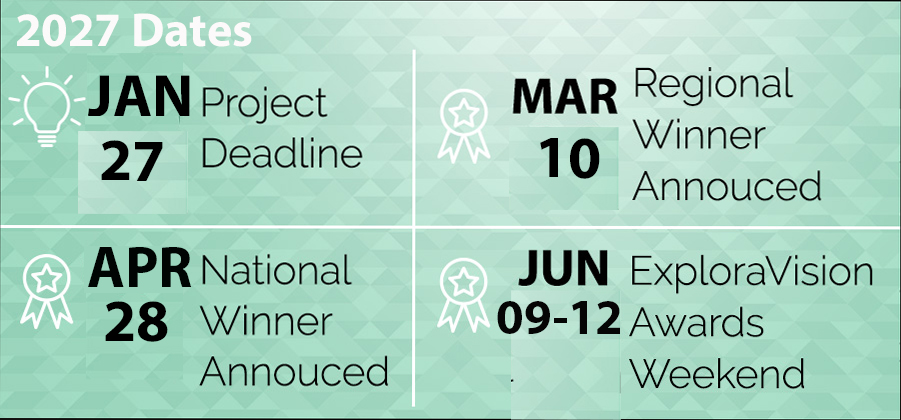
The current official homepage banner gives 27 January 2027 as the project submission date. The rules page still carries an older cycle’s date at the time of checking. We have used the current banner for the competition listing; the coach should also confirm the precise cut-off in the submission system when preparing the entry.
This is a good reason to keep current logistics separate from the scientific idea. The article can remain useful when the calendar changes, but the team should always work from the live competition page, official template and submission system. We have not assumed a participation fee where the checked material did not establish one.
We suggest beginning with a small selection of reliable sources rather than a large folder of loosely relevant links. After reading a source, ask a student to explain one fact it establishes and one question it leaves unanswered. That habit is useful when several teammates divide the reading: everyone needs a shared understanding of the proposed mechanism.
Then challenge the design. What other approach did the team consider? Who might not benefit? What could become less safe, less affordable or harder to repair? These are editorial prompts for a more thoughtful proposal, not a substitute for the official assessment criteria.
A parent or coach can provide structure, help locate suitable reading and ask for clearer explanations. If the adult is doing most of the technical reasoning, the team should simplify the proposal until students can own it. An understandable limitation is preferable to an impressive paragraph nobody can defend.
ExploraVision suits students who enjoy combining research with imagination and can tolerate a substantial explanation of how their idea might work. Its distinctive value is the discipline of separating what is known from what still needs to be invented. Start with a real need, use the correct category template and put scientific clarity ahead of a spectacular-looking future gadget.
EXPLORE NEXT
Guide
A practical guide to the two-minute science video, 2026 eligibility, peer review and what the judging criteria really demand.
Guide
Eligibility, long-form problem solving and the route to the Oxford Training Camp
Guide
A first-year A-level checkpoint for modelling, estimation and unfamiliar problems
Comments
Share a question, note, or update.
No comments yet.