Guide
National STEM Festival UK: Build It, Test It, Share It
How to turn a working project into evidence that survives national review.
Competition Roundups
A guide to some of the most recognised science competitions available to secondary school students in the United Kingdom.
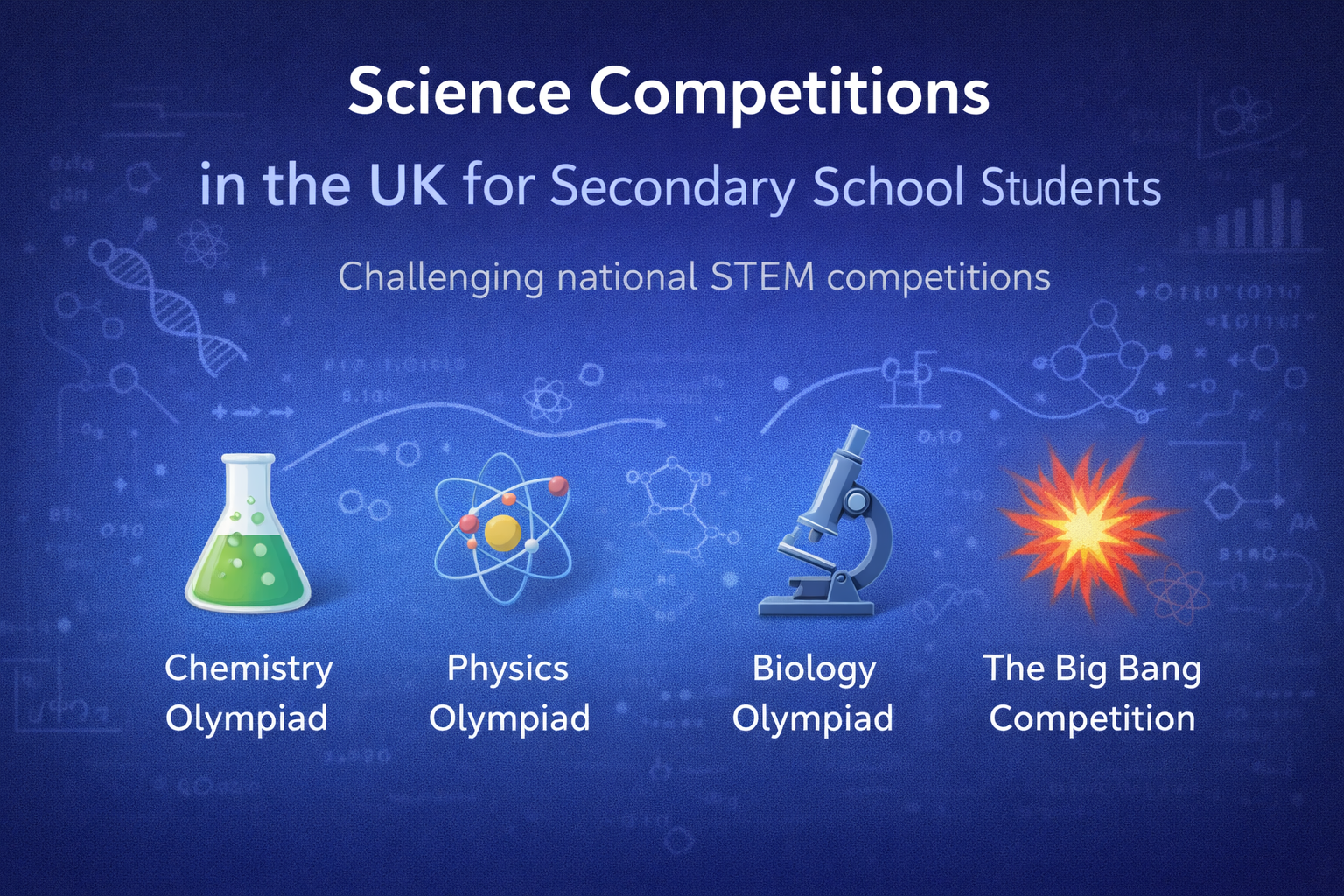
Science competitions give students the opportunity to explore ideas beyond the classroom. They encourage curiosity, independent thinking, and practical problem-solving — skills that are essential in scientific research and innovation.
In the UK, a number of well-established competitions allow students to engage with science through experiments, research projects, and challenging problem-solving tasks. Some are organised nationally through schools, while others involve multi-stage competitions that can lead to international events.
Below are several of the most well-known science competitions available to secondary school students in the UK.
The Big Bang Competition is one of the UK's best-known STEM competitions for young people.
Students submit projects related to science, engineering, or technology. These projects may involve experiments, prototypes, or research investigations.
https://competemap.com/competitions/cmlpk74rj0000j7jazxy9gmuu
Key features:
The competition aims to encourage creativity and innovation in science and engineering.
Official website:
https://www.thebigbang.org.uk
The CREST Awards programme supports project-based STEM learning and research.
Students complete investigations or research projects that demonstrate scientific thinking and problem solving.
CREST offers several award levels, including:
Gold Awards often involve extended research projects that may take several months to complete.
CREST projects are widely used by schools and are recognised by many universities and STEM organisations.
Official website:
https://www.crestawards.org
The British Physics Olympiad offers challenging physics competitions for secondary school students.
These competitions test deep understanding of physics concepts through difficult problem-solving questions.
https://competemap.com/competitions/cmlr3l8xh0000vn2lp1fba22m
Competitions include:
High-performing students may be invited to training activities related to international physics competitions.
Official website:
https://www.bpho.org.uk
The UK Chemistry Olympiad, organised by the Royal Society of Chemistry, is one of the most challenging chemistry competitions for secondary school students.
https://competemap.com/competitions/cmls2ffpg0000vn0qwhahjupm
Features include:
Students typically enter through their schools.
The competition helps identify students with strong chemistry problem-solving ability.
Official website:
https://edu.rsc.org/olympiad
The British Biology Olympiad (BBO) is a national competition testing biological knowledge and reasoning.
https://competemap.com/competitions/cmls3orkd0000vnshn1qct4x1
The competition includes questions across many areas of biology, such as:
Students compete individually, and high-performing students may be invited to further rounds or selection processes connected to international biology competitions.
Official website:
https://www.ukbiologycompetitions.org
Science competitions allow students to:
Participation can also help students discover areas of science that interest them for future study.
Students should consider several factors when selecting competitions:
Some competitions emphasise theoretical knowledge, while others focus on research or project work.
Competition formats, eligibility requirements, and schedules may change each year. Students should always confirm the latest information on the official organiser websites.
To discover verified science, maths, coding, and essay competitions for UK and Ireland students, visit:
CompeteMap helps students and parents explore academic competitions and understand how they fit into long-term learning pathways.
EXPLORE NEXT
Guide
How to turn a working project into evidence that survives national review.
Guide
Problem allocation, shared debugging and the difference between several coders and one functioning team.
Guide
Why code-breaking, networking and AI tasks reward team coverage rather than one fast specialist.
Comments
Share a question, note, or update.
No comments yet.