Guide
British Algorithmic Olympiad: where mathematics becomes an algorithm
A guide to the BAO’s blend of pure mathematics, discrete thinking and programmable problem solving.
Competition Roundups
How to choose the right UKMT Challenge, understand Kangaroo and Olympiad follow-on rounds, and prepare without turning problem solving into another exam.
Content updated: 6 October 2026
The United Kingdom Mathematics Trust runs a family of school competitions rather than one single “UKMT test”. The Junior, Intermediate and Senior Mathematical Challenges give students at different stages a broad entry point into non-routine mathematics, while follow-on Kangaroo and Olympiad papers offer two different kinds of progression. UKMT reports that more than 700,000 young people take part in its maths challenges each year, which explains why the Challenge papers are familiar in so many schools without making them ordinary curriculum tests.
The most important distinction is not simply age or question difficulty. Challenge and Kangaroo papers reward efficient problem solving and accurate answers under time pressure; Olympiad papers ask students to construct full written arguments. A child who enjoys finding clever shortcuts may thrive in a Kangaroo paper, while another who likes explaining why an idea must work may be better suited to an Olympiad route. Neither path should be treated as a consolation prize for the other.
CompeteMap sees the main Challenges as useful mathematical experiences even when a student does not qualify for a later round. They reveal how a student responds to unfamiliar structure, limited time and the possibility that not every question should be attempted. The right preparation is therefore not accelerated syllabus coverage. It is repeated contact with good problems, followed by careful review of the decisions and ideas behind each solution.
| Item | What families should know |
|---|---|
| Organiser | United Kingdom Mathematics Trust, a registered mathematics education charity |
| Main individual Challenges | Junior Mathematical Challenge, Intermediate Mathematical Challenge and Senior Mathematical Challenge |
| Entry route | A school or registered competition centre normally registers and purchases entries |
| Main format | Timed, non-calculator problem-solving papers; current JMC and IMC papers use 25 multiple-choice questions |
| Current delivery | UKMT currently states that its competitions are paper-format only |
| Follow-on routes | Kangaroo papers or written-solution Olympiads, through qualification or permitted discretionary entry |
| What to check each year | Competition date, purchase deadline, price, qualifying thresholds and any format trial |
The three starting points are the UKMT Junior Mathematical Challenge, UKMT Intermediate Mathematical Challenge and UKMT Senior Mathematical Challenge. Their CompeteMap pages show the latest verified dates, entry arrangements and official links.
This guide was last checked on 6 October 2026. UKMT can change annual dates, prices, thresholds and formats. Confirm the current cycle on the relevant CompeteMap competition page and the official UKMT website.
UKMT now states on its Challenge and follow-on pages that its competitions are paper-format only. Schools can purchase posted papers or, where offered, downloadable papers to print in school, but students should not expect to sit the main Challenge as an online test.
That changes the practical preparation slightly. Students need to practise recording answers accurately on paper, teachers need to observe the paper-handling and answer-upload process, and families should distinguish the deadline for purchasing physical papers from the later deadline that may apply to download-and-print entries.
For the 2026 Senior Mathematical Challenge, UKMT is trialling a change to the final three questions. The paper contains 22 multiple-choice questions followed by three questions answered as numbers from 000 to 999, while the total time remains 90 minutes.
This is a trial for that cycle, not a permanent format that should be copied into every future guide. It removes the possibility of eliminating answer choices on the final questions and makes accurate calculation and answer coding more important. Students using older SMC papers should therefore also look at UKMT's current example answer sheet.
The senior follow-on paper is now presented as the Andrew Jobbings Senior Kangaroo. It is a 60-minute paper of 20 integer-answer questions and is open to UK schools through qualification from SMC or permitted discretionary entry.
The name and answer format matter because older articles may simply say “Senior Kangaroo” and leave families expecting another multiple-choice paper. The mathematical role is unchanged: it remains the short-problem alternative to the proof-based BMO route.
| Challenge | Normal upper year group | Current core format | What changes for the student |
|---|---|---|---|
| Junior Mathematical Challenge | England/Wales/Overseas: Year 8; Scotland: S2; Northern Ireland: Year 9 | 60 minutes, 25 multiple-choice questions | First experience of choosing efficient routes through unfamiliar problems |
| Intermediate Mathematical Challenge | England/Wales/Overseas: Year 11; Scotland: S4; Northern Ireland: Year 12 | 60 minutes, 25 multiple-choice questions | Denser algebra, geometry, number and combinatorial reasoning |
| Senior Mathematical Challenge | England/Wales/Overseas: Year 13; Scotland: S6; Northern Ireland: Year 14 | 90 minutes; current format must be checked because 2026 includes a numerical-answer trial | Greater independence, more complex structure and a possible route into BMO |
These are maximum year groups, not target grades that every student must wait to reach. Schools may enter younger students when appropriate. Entering early is useful only when the problems remain challenging but intelligible; repeatedly giving a child papers far beyond their experience can turn curiosity into guesswork.
JMC is often the first large-scale competition paper a student encounters. Its early questions invite participation, while later questions make it clear that the Challenge is testing interpretation and insight rather than how many school topics have been covered.
The most useful goal for a first attempt is not to finish all 25 questions. It is to recognise when a problem has been understood, when another representation might help and when moving on is the sensible decision. A student who solves fewer questions carefully may learn more than one who races through the paper.
IMC covers a wider span of secondary-school experience, so the field contains students with very different backgrounds. The paper still avoids requiring a narrow advanced syllabus, but its stronger questions compress several ideas into a short statement.
This is where students often discover that familiar techniques are not enough on their own. They may need to introduce a variable, draw a better diagram, test a smaller case or notice an invariant before the calculation becomes manageable.
SMC is the main senior entry point into UKMT's individual competition pathway. It is accessible to students who enjoy challenging mathematics, but the later questions are deliberately unlike routine A-level exercises.
The paper tests whether a student can recognise structure quickly and maintain accuracy over a longer session. For students aiming at BMO1, SMC preparation is necessary but not sufficient: the transition from selecting or coding an answer to writing a complete proof requires separate practice.
For a closer look at the senior paper, use our UKMT Senior Mathematical Challenge parent guide.
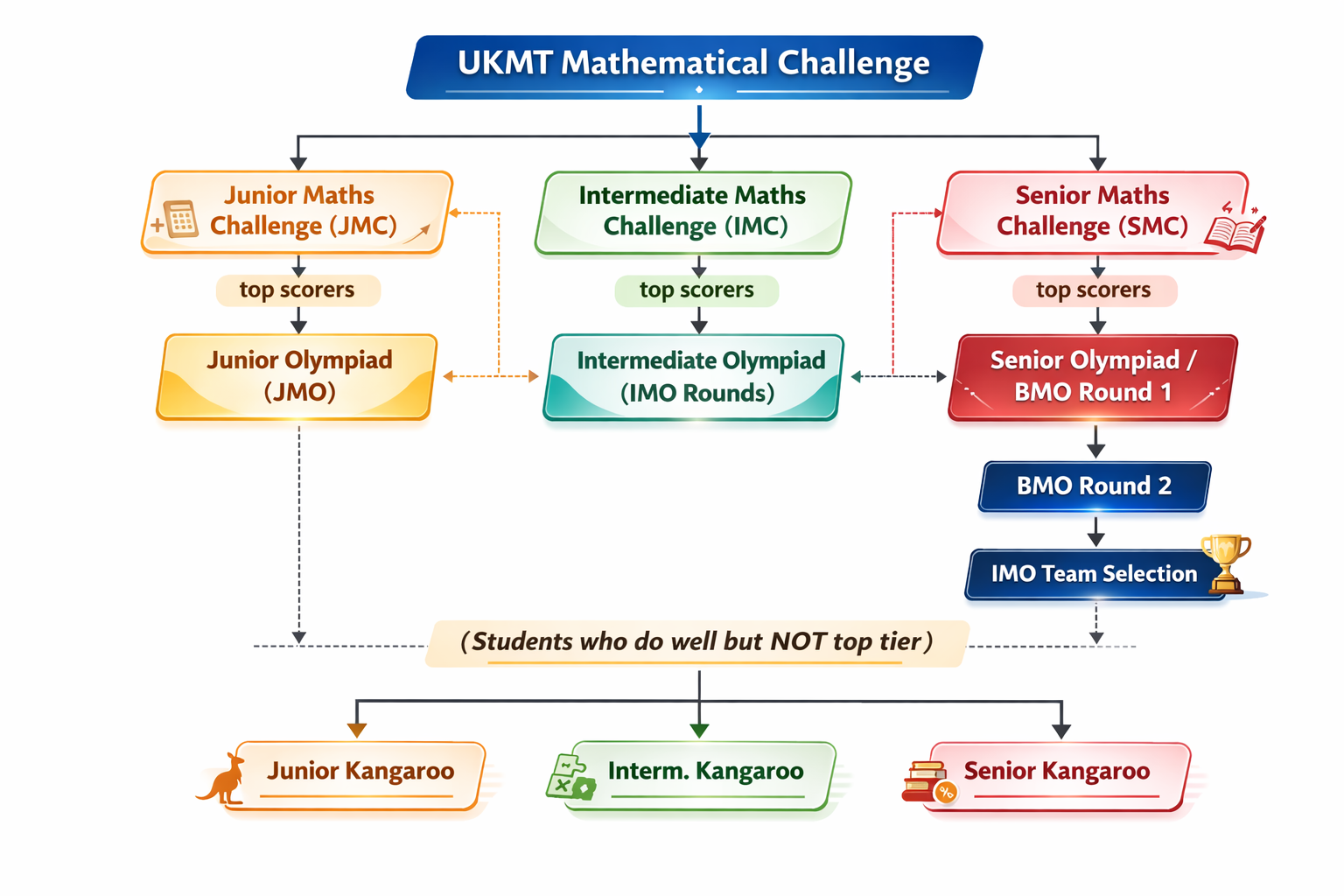
The pathway branches. A high score does not lead every student to the same paper.
| Starting Challenge | Short-problem follow-on | Written-solution follow-on |
|---|---|---|
| JMC | Junior Kangaroo | Junior Mathematical Olympiad |
| IMC | Intermediate Kangaroo, divided into current age routes | Cayley, Hamilton or Maclaurin Mathematical Olympiad, according to year group |
| SMC | Andrew Jobbings Senior Kangaroo | British Mathematical Olympiad Round 1, then possible invitation to BMO Round 2 |
UKMT publishes annual qualifying scores after the main Challenges and may allow schools to purchase discretionary entries under the current rules. A Gold certificate is not a permanent, universal guarantee of a specific follow-on round; thresholds and allocation rules should be checked for the relevant year.
The BMO route is also not an automatic conveyor belt to the International Mathematical Olympiad. BMO1 is an entry point to a much narrower training and selection system. Strong BMO2 performance can lead to further training, but eligibility and selection are governed by the current British Mathematical Olympiad rules.
For the full map, read UKMT Competition Pathway Explained. Families focused on the senior proof route can use our British Mathematical Olympiad pathway guide.
The main Challenges are broad-entry papers built around short problems. Students need to find answers efficiently and manage time across questions that become harder towards the end.
Kangaroo rounds retain the rhythm of a short-problem contest but raise the demand. Depending on the level, answers may be multiple choice or coded integers. Students still need speed, but careless guessing becomes increasingly costly.
Olympiad rounds ask for full written solutions. A correct final number with no explanation earns little credit because the argument is the work being assessed. Students must state why each important step follows and handle exceptional cases rather than relying on an unproved pattern.
The biggest UKMT transition is not “easy paper to hard paper”. It is the move from finding an answer to communicating a proof that another mathematician can verify.
The main JMC, IMC and SMC route is organised through schools or registered competition centres. Parents and students do not normally buy a single main-Challenge place directly from UKMT. The practical first step is to ask the school's mathematics department whether it is a registered UKMT centre and which Challenge it plans to offer.
Schools purchase entries and administer the paper under UKMT's current handbook. Download-and-print options, when listed, still have to be printed and run by the school. The official pages also provide separate deadlines for accessible papers and for uploading answer sheets.
Overseas schools can enter the main Challenges under the listed year-group rules, but not every follow-on round has the same geographic scope. For example, UKMT currently describes the Junior Kangaroo and Andrew Jobbings Senior Kangaroo as UK-schools-only competitions. International families should check the eligibility of the specific follow-on paper rather than assuming that an SMC or JMC result creates the same route everywhere.
The first paper is diagnostic. Let the student work without pressure and mark the point at which the questions stop feeling readable. That boundary is more useful than the raw score because it shows whether the problem is missing knowledge, interpretation or strategy.
After each problem, ask what made the solution possible. Was there a symmetry, a parity observation, a useful diagram, a smaller case or a hidden counting argument? Recording the key idea builds a library of methods without encouraging memorised templates.
Move from small sets of questions to a complete paper. Students should practise leaving a problem and returning later rather than treating every unfinished question as a failure.
Main Challenge students should be comfortable working on paper without a calculator or measuring instruments. SMC students in a cycle using numerical-answer questions should also practise coding three-digit answers exactly as UKMT instructs.
Challenge preparation and Olympiad preparation overlap, but they are not interchangeable. A student moving towards JMO, the Intermediate Olympiads or BMO should practise writing complete solutions and comparing them with official marking guidance, not only solving more multiple-choice questions.
👉 A practical preparation target: complete a small number of past papers deeply. A student who can explain several missed problems is making more progress than one who has rushed through a large archive.
UKMT awards certificates and publishes annual thresholds, but the cut-offs move with the paper and cohort. A certificate is therefore a result from one sitting, not a permanent label for the student's mathematical ability.
Schools may value the recognition, but the deeper evidence is what the student can now do: persevere with an unfamiliar problem, choose a representation, check an argument and explain a solution. The competition should not be presented as a guaranteed advantage in sixth-form or university admissions.
For parents, the most useful result questions are:
EXPLORE NEXT
Guide
A guide to the BAO’s blend of pure mathematics, discrete thinking and programmable problem solving.
Roundup
Why technical education, apprenticeships and national selection form a different route to world-level competition.
Guide
Problem allocation, shared debugging and the difference between several coders and one functioning team.
Comments
Share a question, note, or update.
exceelent
good